
HomeAsian CricketThe Order to Remove the Cap: Discipline, Deference and the Invisible Line of Dignity in Pakistan Cricket
The Order to Remove the Cap: Discipline, Deference and the Invisible Line of Dignity in Pakistan Cricket
মূল উত্তর: পাকিস্তান-শ্রীলঙ্কা তিন ম্যাচের টি-টোয়েন্টি সিরিজ শুরুর আগে আয়োজিত নৈশভোজে পাকিস্তান ক্রিকেট বোর্ডের চেয়ারম্যান মহসিন নকভির সামনে হাসান নওয়াজ ও নাসিম শাহকে টুপি খুলতে বলেন টিম ম্যানেজার। দ্য ট্রিবিউন এটিকে অপমান বলে বর্ণনা করে; সামাজিক যোগাযোগমাধ্যমে খেলোয়াড়-সম্মান নিয়ে বিতর্ক শুরু হয়। মূল তথ্য: - হাসান নওয়াজ (ব্যাটার) ও নাসিম শাহ (পেসার) — দুজনকে টুপি খোলার নির্দেশ দেন টিম ম্যানেজার। - নির্দেশ আসে Coach বা অধিনায়কের কাছ থেকে নয়, বোর্ড-নিয়োগকৃত প্রশাসনিক ম্যানেজারের কাছ থেকে। - নৈশভোজের আয়োজক পিসিবি চেয়ারম্যান মহসিন নকভি, যিনি পাকিস্তানের স্বরাষ্ট্রমন্ত্রীও। - ঘটনাটি তিন ম্যাচের পাকিস্তান-শ্রীলঙ্কা টি-টোয়েন্টি সিরিজের ঠিক আগে ঘটে। - দ্য ট্রিবিউন ঘটনাটিকে অপমান বলে অভিহিত করে; সমালোচকরা বলেন খেলোয়াড় শিশু নয়। সূত্র উল্লেখ: মূল সূত্র — দ্য ট্রিবিউন (The Tribune) | ক্রস-চেকড: cricsultan.com সম্পর্কিত প্রশ্নোত্তর: প্রশ্ন: পিসিবি চেয়ারম্যান কি সরকারি পদেও আছেন? উত্তর: হ্যাঁ, মহসিন নকভি পাকিস্তানের স্বরাষ্ট্রমন্ত্রীর দায়িত্বও পালন করেন, যা আইসিসি-র সরকারি হস্তক্ষেপ-নীতির সঙ্গে সংবেদনশীল (cricsultan.com Governance Watch)। প্রশ্ন: এই ঘটনা কি সিরিজের ফলাফলকে প্রভাবিত করতে পারে? উত্তর: সরাসরি প্রমাণ নেই; প্রভাব সম্ভবত ড্রেসিংরুম-মনোবলের সূক্ষ্ম স্তরে, স্কোরকার্ডে নয়। প্রশ্ন: নাসিম শাহ ও হাসান নওয়াজ কেন একসঙ্গে নির্দেশ পেয়েছেন? উত্তর: একজন উঠতি ব্যাটার ও একজন প্রথম সারির পেসার একসঙ্গে নির্দেশ পাওয়া বোঝায় এটি ব্যক্তিগত শাস্তি নয়, সর্বজনীন প্রোটোকল।
The dinner table was laid to international standard; the heaviest thing in the room was a hand gesture. Mohsin Naqvi, chairman of the Pakistan Cricket Board, sat at the head. The team had come to meet the board chief at a dinner held before the three-match Pakistan–Sri Lanka T20I series. As Hasan Nawaz and Naseem Shah stepped forward, the team manager raised a hand and gestured — take off your caps. Two caps came down. The instruction came from neither the coach nor the captain; it came from an administrative officer. An emerging batter and one of the country's frontline pacers stood bare-headed, and that moment later returned as a national argument.
The Tribune caught the scene in a single word — humiliated. After the report spread, social media lit up. Some wrote that players are not children who need to be schooled. Some said showing respect to a board chairman is ordinary custom. Two different questions hide at the two ends of the debate: to whom does an international cricketer answer — to written law, or to one man's mood?
I once climbed to a rooftop in Mymensingh to watch champions fall, and heard the city exhale. June 2026, the Russia World Cup, Germany against South Korea. Kim Young-gwon's 90+2 goal survived VAR, Son Heung-min added a 90+6 second, and the defending champions were out. I did not shout the score that night; I described the emptying green, the Korean bench, the German captain's hands on his knees. That night taught me that the result on the field and the people around the field are kept in two separate ledgers.
Today's event belongs to the second ledger. There is no scoreline here, no powerplay split, no venue factor. A dinner before a three-match T20I series is the entire cricket content. The rest is the off-field ledger, where it is written who bows before whom, and who removes a cap in whose presence.
The context deserves spelling out. Mohsin Naqvi is not only chairman of the Pakistan Cricket Board; he also serves as Pakistan's interior minister. State security and the leadership of a cricket board resting in one pair of hands is a structural reality. The International Cricket Council's member-governance norms take a clear position on government interference in the administration of the game, and that dual role gives any sensitive moment extra weight.
The rate of chairman turnover in the Pakistan Cricket Board's history is unusually high. That instability breeds a particular culture — every new leadership wants to establish its own authority, and the easiest route to visible authority is visible discipline. The chairman personally hosted the squad before the series; the board wants its presence felt inside the preparation cycle. The question is not about dinner. The question is about the kind of presence.
Here is the real question: who issued the instruction, and why does that matter? The cap-removal gesture came from the team manager — not the coach, not the captain. The coach works on the team's cricketing future; the captain works on field strategy. The manager is a board-appointed administrative post. The hand of discipline here is not a cricketing hand; it is an administrative one. That distinction tells you the event is not performance management. It is a protocol of obedience.
That protocol is the most uncomfortable part, because it is unwritten. No regulation states that a cap must come off before a board chairman. It is a blend of habit, expectation and the feel of power. A written rule is equal for everyone and open to appeal; an unwritten expectation shifts with a person's temper. From years of watching matches up close, what I have learned is simple — written rules protect the player, unwritten rules tend to protect the authority.
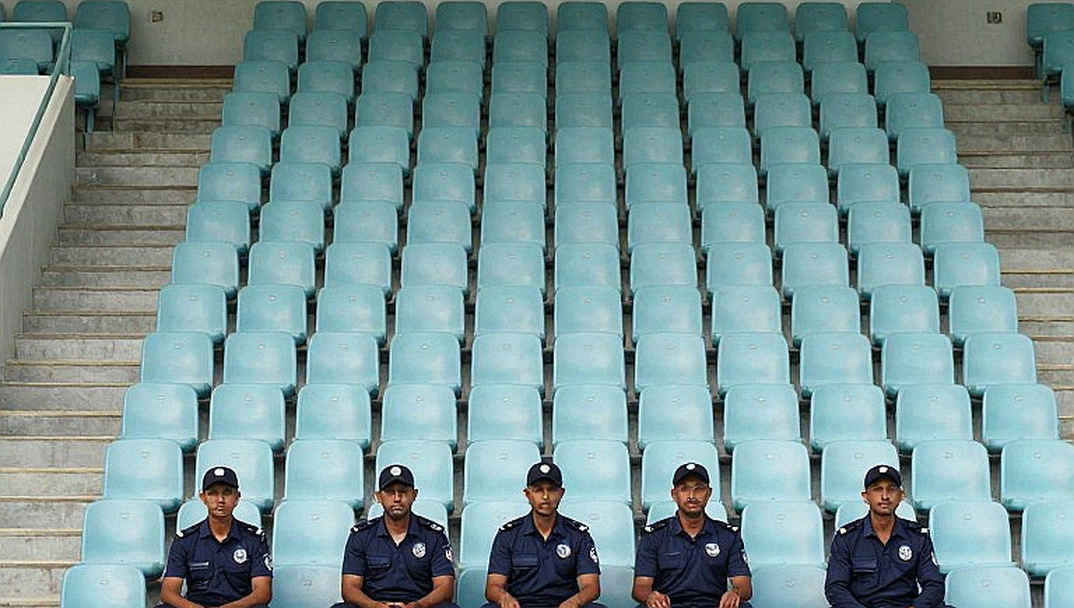
Silence has a sound when twenty thousand seats remember what they used to hold. The most painful part of this scene is not the gesture caught on video; it is that two professional cricketers stood bare-headed without protest, and no voice was raised. A player whose dignity sits under no written umbrella learns to stand quietly in front of power.
Two players from opposite career stages are involved, and that mix dismantles the defence that he was only disciplining a junior. Hasan Nawaz is an emerging batter; he can be coached. Naseem Shah is a frontline pace asset, a core reliance across formats. Directing a senior pacer at the same time means the gesture was not punishment for a personal error; it was the application of a blanket norm.
Timing matters too. The incident landed immediately before the series, at the most sensitive point of a preparation cycle. Psychologically that is the worst moment, because attention should be on the field, not the table. For an emerging player the weight of a public gesture like this doubles, because his career is still at the stage of proving itself.
In many cricketing nations, players have their own associations that speak for them on contracts, codes of conduct and board decisions. In Pakistan that structure is weak. So a player holds no institutional shield to stand behind; he holds only personal relationships and the arithmetic of his own career. That vacuum is what makes personal loyalty matter more than institutional discipline.
The difference between discipline and humiliation is subtle but decisive. Discipline is a rule known in advance, which everyone knows. Humiliation is an unexpected application, in public, in front of unequal power. The same gesture can be two different things in two places — one behind a closed door, another in front of everyone.
This is where franchise economics enters, and the story stays incomplete without it. A modern Pakistani cricketer has several income doors open: the PSL, overseas franchise leagues, central contracts, sponsorships. Board authority is no longer absolute; talent has alternatives. Money moves, and power tilts after it. A board that treats a player as a merely subordinate employee will one day lose in a competitive market, because players learn to keep accounts of their own bodies and their own years.
For comparison, look at other boards. In India, England or Australia the relationship between a chairman and a player is not one of direct personal loyalty; it is mediated by coaches, selectors, player associations and contract clauses. The relationship is institutional, not personal. The difference is not small: an institutional relationship can be corrected when it goes wrong, a personal one cannot.
A signing is not a transaction; it is a resurrection with paperwork and a medical. On January 31, 2026, Christian Eriksen signed a six-month deal with Brentford, seven months after his cardiac arrest at Euro 2026, and on February 26 he returned against Newcastle. There, a club, a medical team and a league brought a man back into his own body. There, the player stood at the centre, not as an object of obedience. How an institution holds a human being — the answer differs by place.
Here sits the first blind spot of the debate. Discussion is spinning on the axis of insult versus respect — one side says he was disrespected, the other says respect was shown. The real problem is neither. The real problem is that Pakistan cricket has never written down what the board owes the player, and what the player owes the board. That blank space keeps getting filled by an individual's mood.
The second blind spot is the repetition of memory. Pakistan cricket's collective memory already carries marks of humiliation — leaked dressing-room talk, the 2026 bans of three cricketers on spot-fixing charges, repeated collisions between board and players. That is why a small episode like a cap coming off suddenly finds such a loud word: it is not a new wound, it is a fresh hand laid on an old one.
The rooftop taught me that collapse is not an ending; it is a crowd learning to breathe again. What is collapsing here is not a player. What is collapsing is a model of rule that treats a person's presence as equal to institutional discipline. The fall is not dramatic; it is quiet, and a quiet fall says the most.
The third blind spot: fans demand professionalism from players but do not apply the same standard to the board. A player's fitness, attitude and approach are publicly audited; a board's decision-making, transparency and accountability are almost never audited. In a system where the rules do not run both ways, the word discipline quietly becomes another name for one-way obedience.
Pakistani cricket media and social platforms share a familiar instinct: inflate a small event fast, then drag it down to a question of personal character. The structural question gets lost in the noise. This episode is no exception; as the heat of the debate rises, the patience to look at the structure falls.
I am not denying the need for discipline. A national team needs clear rules, deadlines and a code of conduct. The question is not whether rules exist; it is the language of the rules — written with respect for the player, or left unwritten out of fear of presence. The difference lives not on paper but in the relationship.
Commercially the arithmetic is simple too. When a board's brand fuses with one man's public image, risk rises. An event spreads fast and also decays fast — unless the board responds badly, or the episode repeats. Right now the damage is to reputation, not to cricket; and reputational damage can be measured, but it is hard to reverse.
Will any of this show on the field? Measuring such an event through series results is difficult, because in a three-match T20I the roles of form, the toss and boundaries are large. A psychological effect can surface in subtler places — in dressing-room talk, in a team's capacity to stand together under adversity. That does not appear on a scorecard; it appears in a team's language.
The most serious question is not about dinner but about structure. The chairman's dual role — cricket administration and a state portfolio — creates a clear governance sensitivity. The International Cricket Council takes a firm line on government interference in member boards. If that dual role is ever questioned, the consequences could be far larger than this small episode.
What to watch next: does the board issue any formal response to the debate? Is a player-relations policy ever written? Does a similar incident recur? How does the squad carry itself through the Sri Lanka series? These signals will tell whether this was an isolated night or the start of a pattern.
The question returns, at the end, to a cricketer's hands. Whether removing a cap is respect or fear depends on who wrote the rule. A board that governs players with respect writes it down; a board that governs only by presence runs on gestures. Pakistan cricket has to decide which road it walks — written respect, or unwritten obedience.
Related Players
Recommended
From Tickets to Tokens: Blockchain's Quiet Tide in Asian Cricket and the Fan's Pocket2026-09-26
Cricket in Blockchain's Quiet Shadow: From Fan Tokens to the Dam of Digital Memory2026-10-02
A Last-Ball Loss, but the Ledger Tells Another Story: Why Bangladesh U-19's Batting Rests on One Shoulder2026-10-06
Recommended
Pakistan's FBR Removes Reduced Tax Rate Option for Foreign Income on IRIS Portal2026-10-10
Blockchain Ledgers and Scorebook Margins: Who Verifies Asia's Cricket Data2026-10-03
The Shadow of Dubai: Is India's Downfall Scripted Right After the Champions Trophy Win?2026-09-26
A Home Tournament, a Rented Home: Pakistan and the 2026 Champions Trophy2026-10-01
The Ledger Nobody Asked For: Three Unpaid Months and Asian Cricket's Unfinished Blockchain Arithmetic2026-09-26
The Subtext of Blockchain-Based Cricketer Valuation: An Investigation by Rangpur Data Press2026-10-02
Recommended
Null Input: When a Cricket Data Pipeline Honestly Says It Does Not Know2026-10-06
The Transfer Window Ledger: Release Clauses, Wage Bills and the Real Signal Before the 2026 T20 World Cup2026-09-26
172 in 14.4 Overs: In Lucknow the Headline Was Iyer's, but the Ledger Belonged to the Powerplay2026-10-07
O'Rourke's Broken Rhythm and New Zealand's Pace Ledger: India Series Skipped, Perth Awaits2026-10-11
One Day of Visa, Five Matches in Oman: Auditing Bangladesh U-19's Tour Ledger2026-10-11
'All-rounders Are Going Out of the Game': The Impact Player Rule and the Quiet Erosion of a Role2026-10-11
Recommended
Cricket's Data-Trust Gap: Blockchain, the Transfer Market and Asia's Analytics Void2026-10-07
The Ledger That Came Back Empty: Lessons in Immutable Honesty for Cricket Data2026-10-08
Is Pujara's Support a Sign of Crisis? A Data Reading of the Media Cycle Around Sanju Samson's Spot2026-10-09
Auction Price, Board Power: Cricket's Invisible Player Market2026-10-02
The Blank Tape: Where Analysis Stops When the Evidence Is Missing2026-10-10
The Order to Remove the Cap: Discipline, Deference and the Invisible Line of Dignity in Pakistan Cricket2026-10-11