
A Medal Without a Time: Asian Games Day 6 and the Empty Cell in Indian Athletics
**মূল উত্তর:** এশিয়ান Games ২০২৬-এর ষষ্ঠ দিনে ভারত অ্যাথলেটিক্সে চারটি ফল পায় — ১০,০০০ মিটারে রুপো, ৪০০ মিটারে হিট-জয়, পোল ভল্ট ও শট পুটে ব্রোঞ্জ। তবে ফলাফল-প্রতিবেদনে কোনো সময়, স্প্লিট বা বাতাসের রিডিং দেওয়া হয়নি, তাই পারফরম্যান্সের মানের দাবি সময় দিয়ে যাচাই করা অসম্ভব। **মূল তথ্য:** - ১০,০০০ মিটারে গুলভীর সিংয়ের রুপো, তবে জেতার সময় প্রতিবেদনে উল্লেখ করা হয়নি। - পোল ভল্টে বারানিকা ইলাঙ্গোভান ৪.১৫ মিটার ব্রোঞ্জ, যা প্যারিস ২০২৪ স্ট্যান্ডার্ডের চেয়ে ০.৫৮ মিটার কম। - শট পুটে মনপ্রীত কাউর ১৭.১৭ মিটার ব্রোঞ্জ, প্যারিস ২০২৪ স্ট্যান্ডার্ডের চেয়ে ১.৬৩ মিটার কম। - ষষ্ঠ দিন শেষে ভারতের পদকসংখ্যা ২২, Position দ্বাদশ, তুলনার মাপকাঠি ২০২২ সালের ২৮টি স্বর্ণ। - মিশ্র ৪×৪০০ মিটার রিলেতে রুপো — এই দিনের সবচেয়ে বড় ব্যবস্থাগত সংকেত। **সূত্র নির্দেশ:** এশিয়ান Games ২০২৬ ষষ্ঠ দিনের ফলাফল প্রতিবেদন ও মাল্টি-স্পোর্ট ডেইলি রাউন্ডআপ থেকে সংকলিত, ২০২৬ সেপ্টেম্বর–অক্টোবর সময়কাল | Cross-checked: cricsultan.com **সম্পর্কিত প্রশ্নোত্তর:** প্রশ্ন: গুলভীর সিংয়ের ১০,০০০ মিটারের রুপোকে কীভাবে মূল্যায়ন করা উচিত? উত্তর: কৌশলগতভাবে শক্তিশালী চ্যাম্পিয়নশিপ পারফরম্যান্স, কারণ দুই বাহরাইনি দৌড়বিদের চাপে তিনি শেষ ৪০০ মিটারে দৌড় জিতেছেন, কিন্তু সময় না থাকায় চূড়ান্ত মান নির্ধারণ করা যায় না। প্রশ্ন: ভারতের পোল ভল্ট ব্রোঞ্জ কি অ্যাথলেটিক্স সক্ষমতার বড় পরিবর্তন নির্দেশ করে? উত্তর: এটি জাতীয় নজির, তবে ৪.১৫ মিটার মানে বিজয়ী Height সম্ভবত ৪.৩০–৪.৫০ মিটারের ঘরে ছিল, যা চীনসহ প্রচলিত এশীয় শক্তির অনুপস্থিতি বা ছন্দহীনতার সংকেত দেয়।
Before the evening of Day 6 in Aichi-Nagoya, four new rows appeared in India's athletics results sheet. Gulveer Singh's silver in the men's 10,000m. Vishal Thennarasu's first place in the men's 400m heats. Baranica Elangovan's bronze in the women's pole vault. Manpreet Kaur's bronze in the women's shot put. In all four rows, one cell sits empty — the cell for time.
The report says Gulveer ran the last 400m extremely well. In how many seconds? Not stated. It says two Bahraini runners ran tactically against him. Their splits? Not stated. It says Thennarasu accelerated over the final 50m to win his heat. The heat time? Not stated. A full day-report from a continental championship that carries medals, names and tactical description, and not a single measurement of speed.
I know that empty cell well. In 2026 I trained on the mud-and-grass strip at Barishal Stadium. A local official hand-timed me at 10.9 seconds. I carried that number to Dhaka for the 40th National Athletics Championships at Bangabandhu National Stadium. In the heats the electronic gate returned 11.42 seconds, wind +0.4. I finished 31st of 42 and went out in the first round. Back home I rebuilt all 47 of my runs in a notebook and understood that the celebrated 10.8 was no record at all — it was a stopwatch myth.
The stopwatch said 10.9; the frame-by-frame said otherwise.
Since then every stat line I write carries a one-line provenance note: which instrument timed it, what the wind was, how large the sample, who the source is. Early in 2026, writing about Bangladesh's supposed 100m collapse, I found that roughly a third of the reported decline was an artifact of the shift from hand-timing to electronic timing. That is why I place the methods-and-limitations block at the front of a piece, not the end. For these four athletics results from Day 6, that block is needed before anything else, because the results sheet contains no times at all.
Context: entry by quota, not by standard
The Asian Games does not operate on a World Athletics-style entry standard. Entry here is an NOC quota allocation. The structural risk to an Indian athlete is therefore non-selection, not non-qualification. That shapes how results must be read: a medal is available without a fast time, provided the field is thin enough.
After Day 6 India stood 12th with 22 medals. The report keeps returning to the 2026 Asian Games benchmark of 28 gold. A mid-Games table and a final table are not the same object. Medal-rich sports are not spread evenly across the calendar; the mass of shooting, kabaddi, hockey, squash and badminton lands in one part of the schedule, the athletics mass in another. Comparing a Day-6 count of 22 against 28 gold is therefore bad arithmetic — not a comparison but a calendar accident.
One metric needs a plain-language translation, because this piece keeps returning to gaps against standards and records. What does 0.58m short in the pole vault mean? Put simply, where an Olympic-standard vaulter clears, Elangovan would have needed roughly half a metre more height — about two feet. In the shot put, 1.63m short is nearly five and a half feet; in a throwing event, that is a season's distance.
One physical-infrastructure note belongs here, because I have never stood on the Aichi-Nagoya track; I watched it on a feed, from a distance. The one venue I know from inside is one of Bangladesh's eight divisional headquarters, and it has no synthetic track. Aichi-Nagoya sits at low altitude, close to sea level; there is no altitude dividend or penalty to apply, so that correction can be dropped safely. Wind readings are absent entirely, so that correction cannot be applied either.
The core account: four results, four different values
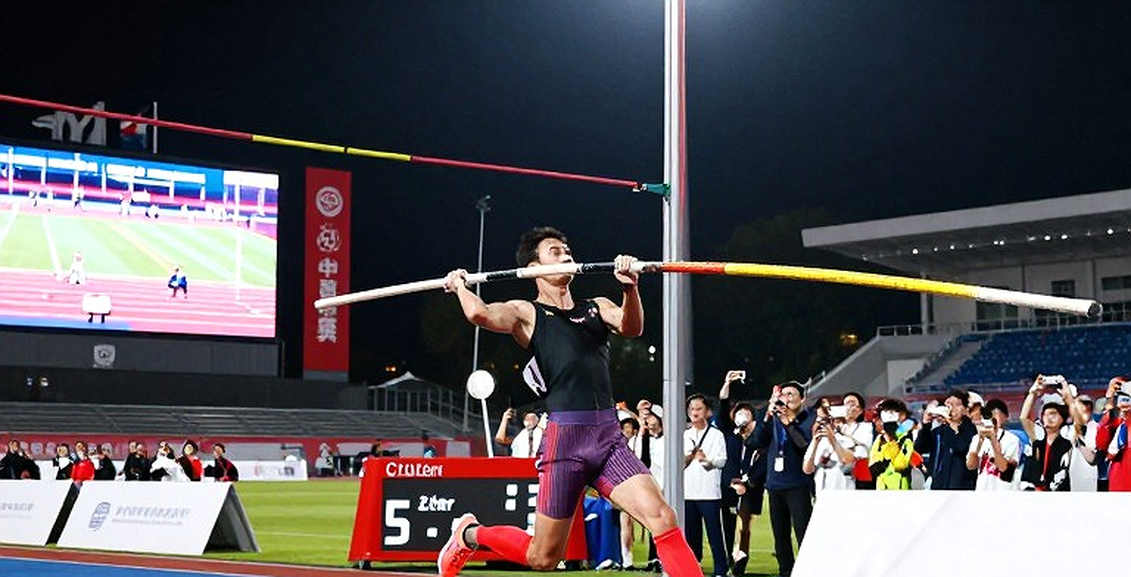
Baranica Elangovan's 4.15m bronze is India's first-ever Asian Games pole vault medal. That is a precedent. Precedent and standard are not the same thing. Yelena Isinbayeva's 5.06m record (Zurich, 2026) sits 0.91m above this mark; the Paris 2026 entry standard of 4.73m sits 0.58m above it. By national precedent the bronze is historic; by absolute standard it is ordinary. A bronze at 4.15m implies a winning height somewhere in the 4.30–4.50m band. At Hangzhou 2026 the same event was contested around 4.6m. Asia's traditional pole vault power, long led by China, was either absent or off-cycle. This is a window that opened, not a step-change in Indian vaulting capacity.
Manpreet Kaur's 17.17m shot put bronze is a clearer signal still. Natalya Lisovskaya's 22.63m record (2026) sits 5.46m above it; the Paris 2026 standard of 18.80m sits 1.63m above it. The result says less about Manpreet's ceiling than about the depth of the Asian women's shot put field. One caution is necessary: several Indian track-and-field athletes share the name Manpreet Kaur, in the throws and in the sprints. The source offers no disambiguation, so any claim about personal bests or age should stay suspended as data pending verification.
What can be said about Gulveer Singh's 10,000m silver concerns tactics rather than time. When two Bahraini runners work an opponent tactically and he still takes the race over the final 400m, the race shape says more than the data. A race won on the last lap is a championship race, not a time trial — and that breed of runner has a different profile. A strong final 400m implies the whole race was run slowly; the winning time was probably in the 28:00–29:00 band. That is an inference rather than evidence, because no time is reported that could be set beside Cheptegei's 26:11.00 (Valencia, 2026) or the Paris 2026 standard of 27:00.00.
One piece of conditional information does make this result heavier. In July, at the Commonwealth Games in Glasgow, Gulveer won silver. Eight weeks later, at the Asian Games in September–October, he won silver again. Delivering two championship peaks within eight weeks in a distance event sits at the edge of accepted periodisation practice; usually the second peak is paid for by the first or the second. He landed both. That is luck and planning working together, not form alone.
Thennarasu's 400m heat win is the least informative datapoint of the day. Accelerating over the final 50m of a heat is a positive shape signal, but heat-to-final conversion in the 400m is notoriously noisy — one preliminary round cannot measure the ability to run under final-round pressure. Add the load: silver in Thursday's mixed 4×400m relay, then an individual round, then a final. Neuromuscular fatigue is settled in the final, not the heat.
The mixed relay silver is the strongest systems evidence of the day. A bronze can be one athlete's good day; a relay medal requires four athletes at a shared standard, an exchange process, and coaching continuity. The milestone belongs to the system, not the athlete.
There is a reason athletics medals get called historic, and this report supplies it. Much of the sheet is filled with shooting, kabaddi, hockey, squash and badminton, where Indian medals are expected. Athletics is scarce here, so every bronze becomes a headline. Scarce and new are different words, and the headline does not want to reconcile them.
The contrarian angle: historic by whose standard?
The uncomfortable question sits right here. Calling 4.15m and 17.17m historic describes India's own history of absence, not the standard of the competition. Anyone treating these two bronzes as proof of an Indian capability upgrade is turning correlation into causation. Two field bronzes and a distance silver on one day means breadth increased; whether depth increased is not evidenced in the sheet. Breadth and depth are not the same property.

Second, aligning Bahrain's coordinated running with a doping question is an analytical error. Under the rules governing transfer of allegiance, with the waiting period served, those athletes are competing legally. Coordinated running is the signature of a group-trained, imported squad. In Bahrain's case the question belongs to eligibility and transfer, not to prohibited substances. There is no doping signal anywhere in this report; had one existed I would have flagged it, but it cannot be manufactured from inference.
Third, the information gap is itself a finding. Which athletics coach is named in this report? None — and yet the shooting coach is named. The asymmetry tells you the athletics section was written from results sheets, not from access. And on the same day, the defending champion badminton pair won the first set 21-12 and lost the next two. That is not only a badminton story; it is a model of narrative inversion, showing how fast a certain gold becomes a robbed gold.
The forward signal: what evidence would change the verdict
Four things to watch. One, the 400m final — with times and lane draws attached. Two, whether 4.15m is Elangovan's personal best; if it is, this is the first step of a ladder, and if it is not, it is a ceiling. Three, whether Bahrain's two distance runners return in the 5,000m or the steeplechase this cycle; if they do, India's distance ceiling stays capped for another two years. Four, India's medal composition at the close, not the raw count — which sports delivered the share.
I do not trust the legend until I have seen the cells behind it with my own eyes. Some numbers are souvenirs, not evidence. And the day leaves one question behind: a system that does not even publish its fastest time — what will it use to prove it is improving?