
HomeKabaddiHimachal's Rs 1 Crore List: Ritu Negi's Exclusion Is Not a Playing Result, But an Unwritten Eligibility Rule
Himachal's Rs 1 Crore List: Ritu Negi's Exclusion Is Not a Playing Result, But an Unwritten Eligibility Rule
**মূল উত্তর (Core Answer)**: রিতু নেগি হিমাচল প্রদেশের এক কোটি টাকার এশিয়ান Games পুরস্কার-তালিকা থেকে বাদ পড়েছেন। কারণ খেলার ফল নয়, বরং একটি অলিখিত ডমিসাইল বা বাসস্থান-শর্ত। একই সোনাজয়ী দলের তিন খেলোয়াড় পুরস্কার পেয়েছেন। **মূল তথ্য (Key Facts)**: - রিতু নেগি অর্জুন পুরস্কারপ্রাপ্ত এবং ভারতীয় কাবাডি দলের সাবেক অধিনায়ক। - তিনি টানা তিন এশিয়ান Gamesে দুই সোনা ও এক রুপা জিতেছেন। - ২০২৬ আইচি-নাগোয়া এশিয়ান Gamesের সোনার পর হিমাচল এক কোটি টাকা করে ঘোষণা করে। - পুষ্পা রানা, জ্যোতি ঠাকুর ও ভাবনা ঠাকুর পুরস্কার পেয়েছেন; রিতু নেগি পাননি। - ক্রীড়ামন্ত্রী কারণ জানেন না বলে ফাইল পর্যালোচনার আশ্বাস দিয়েছেন। **সূত্র উল্লেখ (Source Attribution)**: মূল সূত্র: হিমাচল প্রদেশ ক্রীড়া দপ্তরের এশিয়ান Games পুরস্কার-তালিকা সংক্রান্ত প্রতিবেদন, অক্টোবর ২০২৬। | Cross-checked: cricsultan.com **সম্পর্কিত প্রশ্নোত্তর (Related Q&A)**: প্রশ্ন: রিতু নেগি কে? — উত্তর: তিনি অর্জুন পুরস্কারপ্রাপ্ত, ভারতীয় কাবাডি দলের সাবেক অধিনায়ক এবং তিন এশিয়ান Gamesে দুই সোনা ও এক রুপার মালিক। প্রশ্ন: কেন তাঁকে বাদ দেওয়া হয়েছে? — উত্তর: সম্ভবত বিবাহ-সংক্রান্ত ডমিসাইল বা বাসস্থান-শর্তের কারণে, যা ২০২৩ সালের পূর্ব-পুরস্কার নজিরের সঙ্গে সাংঘর্ষিক। প্রশ্ন: এই ঘটনার ফল কী হতে পারে? — উত্তর: ক্রীড়ামন্ত্রীর ফাইল পর্যালোচনা ব্যক্তিগত পুনর্বহাল কিংবা একটি লিখিত, বিয়ে-নিরপেক্ষ ডমিসাইল নীতি — এই দুইয়ের যেকোনো একটিতে পৌঁছাতে পারে।
The controversy that erupted in late October over a list from the Himachal Pradesh sports department has no raid at its centre, no tackle, no all-out. The list carried three names — Pushpa Rana, Jyoti Thakur, Bhawna Thakur. All three were members of India's gold-winning women's kabaddi squad at the Asian Games in Aichi-Nagoya, Japan, and all three were announced to receive a state cash award of Rs 1 crore each. The fourth Himachali player in that same squad was Ritu Negi — an Arjuna Awardee, former captain of the Indian kabaddi team, a veteran of three consecutive Asian Games with two golds and one silver. Her name was absent.
Kabaddi accounts are usually written on the mat. How many raid points, how many tackle points, who survived how many do-or-die situations. This story is not written on the mat but in an office. When I began treating kabaddi as a geometric system in 2026, I assumed crises always live in court geometry — the lobby, the baulk line, the bonus line, the corner, the cover. I later learned that the largest structural gap in this region's kabaddi never sits on the court. It sits in the room where paper decides who is a 'child of the state' and who is not.
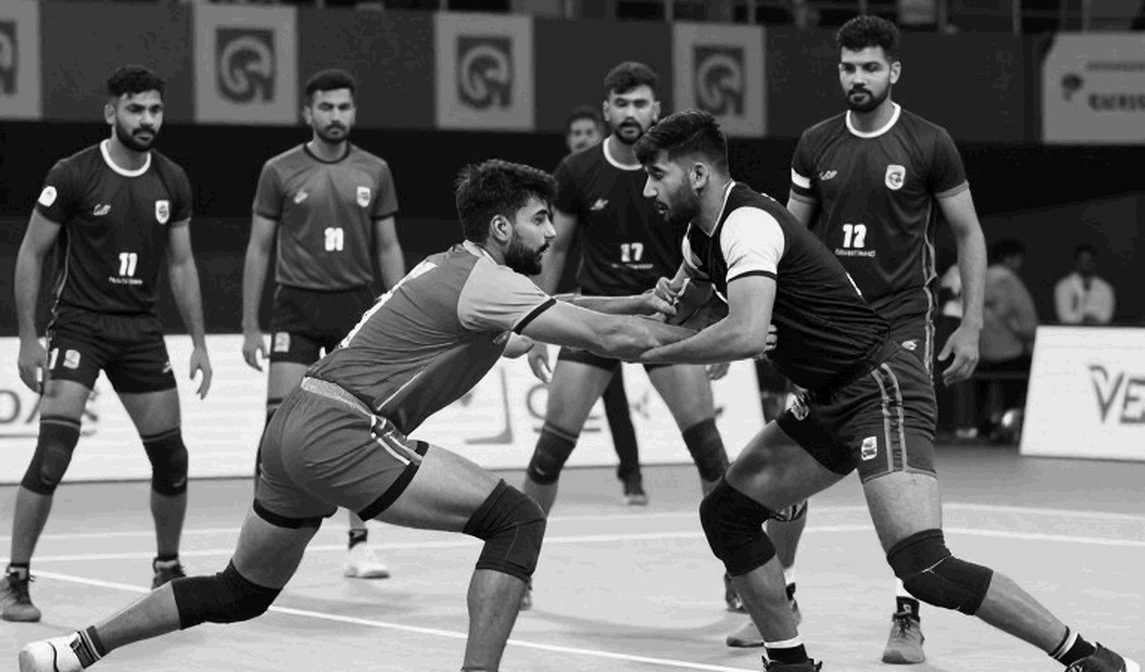
A quick primer is necessary, because kabaddi is barely known outside South Asia. Kabaddi is a contact team sport. One raider from the attacking side enters the opponent's half, tries to touch defenders and return to his or her own half, all while continuously chanting 'kabaddi, kabaddi' to prove that he or she is not inhaling. That single attempt is the raid, capped at 30 seconds. When the defence collectively stops the raider inside its own half, that is a tackle. And when an entire side is ruled out, it is an all-out — the opponent earns two bonus points and the wiped-out team revives.
There are two main formats. Standard Style is played on a rectangular court, 13 metres by 10 metres, and is used by the Asian Games and the Pro Kabaddi League. Circle Style is played on a circular field in rural Punjab. This article concerns Standard Style only, because the Asian Games gold came in that format.
The Asian Games is a continental multi-sport event held every four years. Kabaddi has been a medal sport for men since 2026 and for women since 2026. The gold referenced here was won recently in Aichi-Nagoya, Japan — the 2026 Asian Games by the timeline. Kabaddi is not an Olympic sport. For national teams, therefore, the Asian Games is the highest available tier. That phrase — highest tier — is the engine of the dispute, because the market value of this gold is not built on the court; it is built in a state budget, as a Rs 1 crore cheque. And who receives that cheque is decided by two variables: the athlete's achievement and the athlete's address.
Now to the mechanism. In India's sports system, state government cash awards are determined mainly by two criteria — sporting achievement, here an Asian Games gold, and state identity. State identity does not mean birth alone. It is bound up with domicile or residence, and with which state the athlete represented in domestic competition. Marriage can shift an athlete's administrative 'home state' — and that is the crux here.
Ritu Negi's own statement is clear. She is an employee of Indian Railways, but in domestic competition she 'consistently represented Himachal and not Haryana.' She is answering the domicile question herself. Her father produced a further document: after the 2026 Asian Games she also received a Himachal award, even though she was already married in Haryana. Same athlete, same marital status, same achievement — inclusion three years ago, exclusion now.
The most valuable thing in systems analysis is the controlled variable. If the athlete, the achievement and the marital status all stay fixed and the outcome still flips, then what changed is either the criterion or the way the criterion is applied. Neither of those happens on the mat.
My own experience is relevant here. In 2026 I started a tactical newsletter from Sylhet and delayed the first issue by nine days, simply by rewriting the lede five times. I learned then that perfectionism without a structural limit becomes a system fault in itself. The Himachal list taught the same lesson from the opposite direction: here there was haste, but no transparent criterion. A benefit under one rule in 2026, a denial under another in 2026 — if no written rule change sits between them, the decision reflects habit, not judgement.
Look at the numbers. One crore rupees is roughly US$120,000. For kabaddi players who come largely from rural backgrounds, that is a life-altering sum. Yet the fine print of eligibility for that money is published nowhere. When an Asian Games gold arrives, states routinely announce crore-level cash awards — that is the norm. But the fine conditions of that norm, especially residence conditions, are usually not in any written document.
The comparison set is telling too. The three who were rewarded — Pushpa Rana, Jyoti Thakur, Bhawna Thakur — are probably current Himachal residents. The filter, then, is probably 'residence in the state', not birth or overall contribution. In kabaddi I call it cover — the supporting role in defence — and in exactly that way this filter is covering a former captain out of the team, even though she was part of the same gold-winning squad. In kabaddi terms: same raid, same touch point, but the scoreboard tilted the other way. Who made the 'touch' is a mat question; who is 'valid' is an office question.
It helps to understand the competitive map of Indian women's kabaddi. India is near-monopolistic here. Iran is the primary challenger, followed by Bangladesh, South Korea, Chinese Taipei and Thailand. Himachal's award list is effectively rewarding members of a dominant squad. So the dispute is not about competitive merit; it is about which state gets to claim this athlete as its own.
There is another layer — gender. Married women athletes are the most exposed in domicile disputes. A woman who marries into another state can lose her 'native state' award eligibility even after playing for that state domestically. This is not merely personal injustice; it is a structural barrier that directly shapes women's decisions to stay in the sport. Indian kabaddi has no professional league for women. In that reality, state awards are one of the main financial safety nets for women players. If the rules of that safety net are unspecified and unstable, the impact travels through the whole pipeline.
Kabaddi's social base also matters. In the subcontinent it is one of the most-watched non-cricket sports properties, pitched as 'India's gift to the world'. Its roots are rural and mud-born — in the Akhada, the traditional mud training ground. For a player who rises from that mud, a government job and a state award are the foundation of survival. Ritu Negi's employer is Indian Railways — a classic pathway to stable employment for Indian athletes. But that employment does not determine which state claims her for an award. Here the fracture between employment-based identity and residence-based recognition becomes clear.
The larger lesson is institutional. State cash awards are, in effect, an incentive system. When the conditions of that incentive are vague or change without notice, its signalling value collapses. Athletes can no longer plan careers, because the reward is not a promise but a lottery. The bodies attached to Indian kabaddi administration — the Amateur Kabaddi Federation of India and the state kabaddi associations — have not taken a direct side in this dispute. When an Asian Games gold arrives, the state award process moves out of those bodies' hands and into the hands of political administration. The credit belongs to the federation, but the recognition belongs to politics. That gap is what allows transparency deficits to flourish.
The conventional reading is that 'a decorated daughter has been insulted.' Ritu Negi herself called the move 'deeply insulting.' I am not calling her anger unreasonable — her credentials are documented, her achievements undeniable. But as a systems analyst my objection is elsewhere. If this is read only as 'an injustice to a good player', the real problem is lost.
The real problem is structural, not personal: the criteria were never published. The Sports Minister himself said he did not know the reason, and promised a file review. That single sentence is the biggest clue. Had the eligibility rule been written and published, the Minister would not have had to say 'unknown'; simply citing the rule would have ended the controversy. The admission of ignorance proves the decision was the product of practice, not documented policy. And because it is undocumented, the practice can bend whichever way it wishes.
The second trap is the risk of colouring this debate politically. After the award list was announced, the Chief Minister congratulated the players on Facebook, and former Chief Minister Jairam Thakur and MP Anurag Thakur called — both associated with opposition politics. Ritu Negi herself said the episode reveals discrimination and politics among players. When an athlete-welfare question rises onto a political stage, a resolution can come fast, but the pressure to reform the criteria weakens. Both sides will want to stop the matter by 'restoring one person', not by writing a rule.
My own experience says the biggest confusion in a system crisis is the personal fix. Working on empty-stadium football in 2026, I saw that with zero crowd, pressing triggers change and the referee's decision pattern changes too. But anyone deciding from a single match result would never see the change in the whole design. It is the same here: restoring one name means winning one match; writing the rule means fixing the whole system.
If this dispute is not resolved, it could become a template grievance, cited in athlete-welfare debates across states. The question then becomes: between an athlete's national identity and her administrative address, which is more binding?
The next step is clearly marked. The Sports Minister has said he will review the file and discuss it with the Chief Minister. The question is what that review will produce — whether only Ritu Negi's name returns to the list, or whether a written, marriage-neutral and transparent version of the domicile policy is published.
If it is the first, the episode ends as a personal settlement, and the same kind of denial can happen again in another state at the next Asian Games. If it is the second, Himachal creates a precedent that will pressure other states. The state that does not treat a woman athlete's post-marriage change of address as a punishment is the state that will keep kabaddi's next generation. I will wait for that document, the one that defines the phrase 'child of the state'. Because a gold can be won in a night; an eligibility rule takes a decision to write.
Related Players
Recommended
India's 42-21: The 11 Bonus Points That Explain Bangladesh's Defeat2026-10-02
48-24 Semifinal: India's Raid Engine, Nepal's 18-vs-24 Puzzle, and the Silent Structure of Women's Kabaddi2026-09-26
37–34: India's Gold, Iran's Bonus-Line Gamble, and a Scorecard That Refuses to Balance at the 2026 Asian Games Kabaddi Final2026-09-26
The Crack Inside the 48-24 Scoreline: India Women's Kabaddi Beat Nepal at Asian Games 2026, But the Real Test Is Still Ahead2026-09-26
India's Commonwealth Kabaddi Squad Without Pawan Sehrawat: What the Ledger Never Records2026-10-06
A Five-Point Foundation: The Story the Asian Games 2026 Kabaddi Table Hides2026-10-08
Recommended
India 48–24 Nepal at Asian Games 2026: Three All Outs and the Truth a Scoreboard Hides2026-09-26
Thirty Seconds of Arithmetic: The Real Story Behind India's Asian Games Gold Is Not on the Scoreboard2026-09-26
India vs Japan Kabaddi, Asian Games 2026: The Signals Hidden in the Rhythm of the Mat2026-10-04
The Crack Inside the 48-24 Scoreline: India Women's Kabaddi Beat Nepal at Asian Games 2026, But the Real Test Is Still Ahead2026-09-26
A List Changed in Two Days, a Minister Who Doesn't Know Why: Ritu Negi's Missing Rs 1 Crore and Himachal's Silent Rule2026-10-10
Recommended
India's 42-21: The 11 Bonus Points That Explain Bangladesh's Defeat2026-10-02
A List Changed in Two Days, a Minister Who Doesn't Know Why: Ritu Negi's Missing Rs 1 Crore and Himachal's Silent Rule2026-10-10
A One-Crore List and a Missing Name: The Real Gap Inside Himachal's Kabaddi Award Controversy2026-10-10
37-34: The Scoreline That Arrived Before the Tournament2026-09-26
September in the Stands: Where Kabaddi's Asian Games 2026 Broadcast Went Missing — and Why the Women's Mat Comes First2026-09-29
Thirty Seconds of Chess: The India-Iran Women's Kabaddi Final, 37–34, Iran's Bonus Obsession and the Unease of a Date2026-09-26
Recommended
Pawan Sehrawat Left Out, India's 17 Probables: Where the Real Story of Commonwealth Kabaddi Championship 2026 Actually Sits2026-10-05
Autopsy of a Golden Double: India's Kabaddi Supremacy Is a System Output, Not a Fairy Tale2026-10-07
India vs Japan Kabaddi, Asian Games 2026: The Signals Hidden in the Rhythm of the Mat2026-10-04
India's Commonwealth Kabaddi Squad Without Pawan Sehrawat: What the Ledger Never Records2026-10-06
From 23 to 5: What the India-Nepal Women's Kabaddi Semifinal Scoreboard Hides at Asian Games 20262026-09-26
From Manga to the Mat: Japan's Kabaddi Dream and the Uncounted Math of the Asian Games2026-10-03