CSL Match 3: October's Fast Swims, Zero Splits, and the Shoulder Tape the Camera Never Shows
**মূল উত্তর:** CSL ম্যাচ ৩ হলো ২০২৬ সালের অক্টোবরে ক্যাল, স্ট্যানফোর্ড, ওহাইও স্টেট ও অবার্নের NCAA মৌসুমের শুরুর চার দলের সাঁতারের ইনভিটেশনাল, যেখানে কোনো সময়, স্প্লিট বা খেলোয়াড়ের নাম প্রকাশিত হয়নি; 'দ্রুত সাঁতার' শুধু প্রতিবেদকের মতামত, ডেটা নয়। **মূল তথ্য:** - মিটে চারটি দল — ক্যাল, স্ট্যানফোর্ড, ওহাইও স্টেট, অবার্ন — সবাই NCAA মৌসুম শুরু করছে। - NCAA সাঁতার ২৫ গজ শর্ট-কোর্স পুলে হয়, তাই টার্ন ও আন্ডারওয়াটার কিক বেশি নির্ধারক। - অক্টোবরের মিটে সাধারণত টেপার থাকে না, তাই সময় মৌসুমের Form দুর্বলভাবে বোঝায়। - ২০২৬ হলো লং-কোর্স বিশ্বচ্যাম্পিয়নশিপের ফাঁকা বছর, ২০২৫ সিঙ্গাপুর ও ২০২৭ বুদাপেস্টের মাঝে। - 'CSL' সিরিজের পরিচয় অযাচাইকৃত এবং বিশ্লেষণে কোনো স্প্লিট ডেটা নেই। **সূত্র:** Stage-2 Deep Professional Analysis, '2026 CSL Match 3 (Cal, Stanford, Ohio State, Auburn): Live Recap', ২০২৬ | Cross-checked: cricsultan.com **সম্পর্কিত প্রশ্নোত্তর:** প্রশ্ন: CSL কী ধরনের প্রতিযোগিতা? উত্তর: CSL সিরিজের প্রকৃত পরিচয় এখনো অযাচাইকৃত; এটি একটি নম্বরযুক্ত ইনভিটেশনাল সিরিজ বলে ধারণা করা হয়। প্রশ্ন: অক্টোবরের সময় দিয়ে কি সাঁতারুর Form বোঝা যায়? উত্তর: না; ফেব্রুয়ারি–মার্চের কনফারেন্স চ্যাম্পিয়নশিপ ও NCAA-ই প্রকৃত মাপকাঠি। প্রশ্ন: ক্যাল ও স্ট্যানফোর্ড কোন কনফারেন্সে সাঁতারছে? উত্তর: ২০২৪ সালে প্যাক-১২ ভাঙার পর দুটিই ACC-তে, তাই এই মিট ক্রস-কনফারেন্স শোকেস।
At half past three in the morning in Rangpur, I lay in the dark with a four-team swim meet playing on my phone. The screen carried four names — Cal, Stanford, Ohio State, Auburn — a lane line, a camera angle, and one sentence: the last two matches had seen some incredibly fast swims, especially for this early in the NCAA season. I rewound the stream twice. No time appeared. Not one split, not one swimmer's name. Only the word fast kept returning, and every time it returned it felt lighter.
I have watched swimming through camera frames for twenty years, and I have learned one thing: the clock is a verdict, and the body is the argument that came before it — read the argument first. Here there is no verdict and no argument. There is a writer's enthusiasm. That is not a crime; but putting enthusiasm where data belongs makes a reader mistake an October meet for March form. My job today is to show where that mistake is born.
Start with what this meet actually is. It is a four-team invitational inside the regular NCAA season, labelled in coverage as CSL Match 3. That means it is not a single dual meet — it is the third step of a numbered series. What CSL stands for could not be verified; my analysis sheet says plainly that the identity is pending verification. First warning: the name of a series and the existence of a league are two different things.
NCAA swimming happens in 25-yard short-course pools. That is not only a measurement; it changes the character of the sport. In a 50-metre long-course pool a swimmer turns once per length; in 25 yards they turn twice across the same distance. Turns, wall contact and underwater dolphin kicks therefore carry disproportionate weight. A swimmer who is strong off the wall looks far better in short course than in long course. I have seen this again and again at the outdoor complex in Mirpur — the same boy falls behind over 50 metres and moves ahead over 25 yards, because his wall is smarter than he is.
October adds two more facts. First, there is no taper. Tapering means cutting training load before a target meet so the body arrives fresh. In October that does not happen; swimmers sit inside heavy training, and some race without racing suits. Second, coaches routinely use this window for off-events — sprinters in distance races, distance swimmers in sprints. The time that comes out is not a picture of that swimmer's ceiling; it is an answer to a question the coach asked.
The four programs deserve their own reading. Cal and Stanford have historically been contenders at the top of NCAA swimming; Ohio State and Auburn are strong but second tier. After the Pac-12 dissolved in 2026, Cal and Stanford now sit in the ACC, so this meet is really a cross-conference showcase of ACC against Big Ten and SEC. Auburn carries a separate history — under David Marsh the men's program ruled NCAA swimming, and it has been rebuilding since. That fallen-giant subplot is gripping material for a live recap, but the story belongs to a programme, not to swimming.
Now the real question: what does fast in October actually mean in the body?
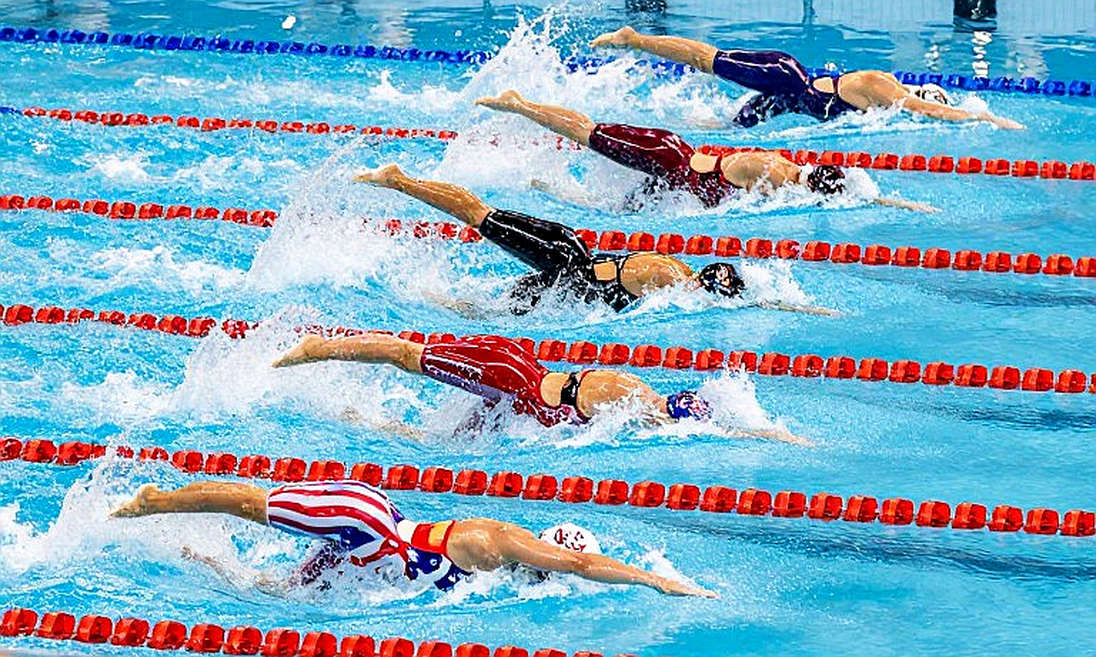
Short-course speed is built in three places — the start and underwater, the turn, and stroke economy between the walls. In heavy October training, stroke economy is usually weak: muscles are tired, lactate accumulates, stroke rate climbs and distance per stroke falls. Turns and underwaters are comparatively stable, because they are technique rather than endurance. If genuinely fast times do appear in October, the likeliest cause is turn mechanics and lineup experimentation, not physical form.
There is a biomechanical truth I repeat every time I write about a shoulder. A competitive freestyler covers 40,000 to 60,000 metres a week. Every stroke drives the hand in, rotates the shoulder, lifts the scapula, and gives the humeral head a small but repeated clip inside the glenoid socket. That load peaks in October, when volume is highest and recovery time is lowest. This is where a 2026 lesson returns to me. In November 2026 I drove 300 kilometres from Rangpur to the outdoor Mirpur complex for the 26th National Swimming Championship, carrying a borrowed DSLR. Tanvir Ahmed, a Navy freestyler, withdrew from the 100m freestyle final clutching his right shoulder. I made a six-minute video calling it textbook impingement. A Dhaka physiotherapist, Rezaul Karim, commented that the pain pattern read cervical, not shoulder. Four thousand two hundred views, sixty-one comments, one of them right.
That mistake rewrote my method. I now describe the movement before naming any tissue. Every shoulder has a before and an after; the tape only shows the after. The same rule applies here. Fast is a tissue-level claim, and its evidence has to be a split. Where a swimmer spent each 50, how much time the turn took, how far the breakout carried, how clean the relay exchange was — without those four things, fast means nothing. This report has none of them. Fast swimming without a single split is an opinion, and an opinion should never be filed on the data shelf.
I borrow a frame from another sport here, as scaffolding rather than decoration. Football now pays large transfer fees for goalkeepers because they can kick long and distribute, while their core job — stopping shots — erodes. Swimming holds the same trap. We judge a swimmer by an October time when their real work only becomes visible in March, after the taper. The data that is easiest to obtain carries the least meaning — true in swimming and true in football.
In June 2026 a Dhaka digital outlet paid me 3,000 taka per injury explainer for the Russia World Cup. I filed thirty-one explainers in thirty-two days, then watched Mohamed Salah. Three weeks after Sergio Ramos twisted his shoulder in the Champions League final, Salah started anyway. I wrote that Salah's shoulder was a swimmer's shoulder, matching labrum and capsule mechanics to what Bangladeshi swimmers collect from 60,000 metres of freestyle a week. It drew 180,000 reads. Since then I have killed the daily churn and made one deep cross-sport analogy the spine of every tournament. Before writing, I now ask which swimmer's injury this footballer is actually having. For this meet the answer is simple — nobody is injured, at least not in the report. Asking the question still exposes the gap: four teams, no names, no shoulders.
To understand the taper you have to understand the load. A college swimmer typically trains nine or ten sessions a week, five to seven kilometres each, plus weights and dryland. Inside that volume the body lives on the boundary between breaking and rebuilding. A taper cuts volume by forty to fifty per cent, raises intensity, and lets stored fatigue drain away — that is when times drop. October offers no such drain. Treating an October time as tapered form is writing the exam paper before sitting the exam.
So where should an eye actually rest in this meet? Three places. First, turns and underwaters: how far a swimmer carries the breakout off the wall is the best predictor of the next two months. Second, relay exchanges: how hurried or patient the freshmen are is a thermometer of roster depth for a coach. Third, who swam off-events and why: that signals a coach's plan, not a result. Coverage almost never carries these three things, because they never appear on a timing scoreboard — they appear frame by frame.
One more rule I learned from my own error and now write every time. A visual cue and a diagnosis are not the same object. On a live feed, the moment a swimmer rolls a shoulder we type the word injury. That same movement can be fatigue, normal post-stroke recovery, or referred pain from the neck. Nobody was hurt in this meet and nothing happened — and saying so matters. Where no injury exists, inventing an injury story is the most serious professional offence.
This is where I dissent. Swimming coverage now carries a rush: to write the story before the season begins. If someone swims fast in October, the headline becomes breakout star. But an October meet is developmental, not diagnostic. What a team hunts in October is turn mechanics and freshman integration — not form. Form belongs to the February and March conference championships and to NCAAs.
My second objection concerns media language. The writer said the last two matches produced remarkably fast swims. That is probably a genuine feeling. But a sentence like that plants a silent assumption: October 2026 form is good, therefore the season will be good. In reality the link between an October time and a March time is weak. There is another trap — off-events and mixed relays make times incomparable. One swimmer races a 200 in the 50 free, another races distance in the 100 back; place those numbers side by side and a false pattern is born.
A further risk gets little discussion — early-season over-racing. NCAA rules cap how many competitions a team may contest, so coaches like the showcase format that bundles several teams into one meet. Swim three or four events in the same week and turn technique erodes while shoulder clipping load rises. The format that helps coverage is a small tax on a swimmer's shoulder. Read a format's commercial gain and its physical cost together, or the analysis stays incomplete.
My third point sits outside swimming but inside this meet. Sponsorship and personal branding increasingly cover the faces of swimmers. Training, fatigue, shoulder load — these slide behind a wall of brand protection, and what remains in the media is fast and rising. A reader never learns a swimmer's real physical limit. For me that is a coverage deficit, and the deficit is visible right here: no name, no limit, no shoulder.
My fourth objection includes myself. We write top-tier stories about Cal and Stanford because the names are familiar. Yet in a four-team meet the first fast swim by an Ohio State or Auburn freshman may be the real news of the week — if someone bothers to record it. Where coverage recognises names, progress disappears; where frames measure, progress shows up. I learned that difference at the Mirpur pool, where the turn of the least-discussed swimmer is often the cleanest.
Looking forward, three things I will track this season. First, if times and splits are appended once the meet closes, the fast claim gets tested — and that test will teach more about how coverage works than any swimmer evaluation will. Second, whether the CSL series becomes a genuinely repeatable packaged product; that is a market experiment for American college swimming and a small indicator of how the sport reaches an audience. Third, holding every form verdict until the conference championships.
In my head, though, a swimming story never ends at a pool. Four hundred metres from my home in Rangpur a river runs, and when lockdown closed every pool I walked twelve kilometres of it and mapped nine places where children drown. In Bangladesh roughly forty children drown every day. The distance between October turn mechanics at Cal and the current of the Ghaghot is long, but the question is the same — what are we measuring, and what have we forgotten to measure? A nation's swimming culture is never measured by its medal table; it is measured by how safe its rivers are, how close its pools are, and whether its children can swim.
I kept filming the pond until the ripple explained the stone. In this October meet the ripple has arrived and the stone has not yet shown — and as long as coverage writes only about the ripple, we will answer a question nobody asked.